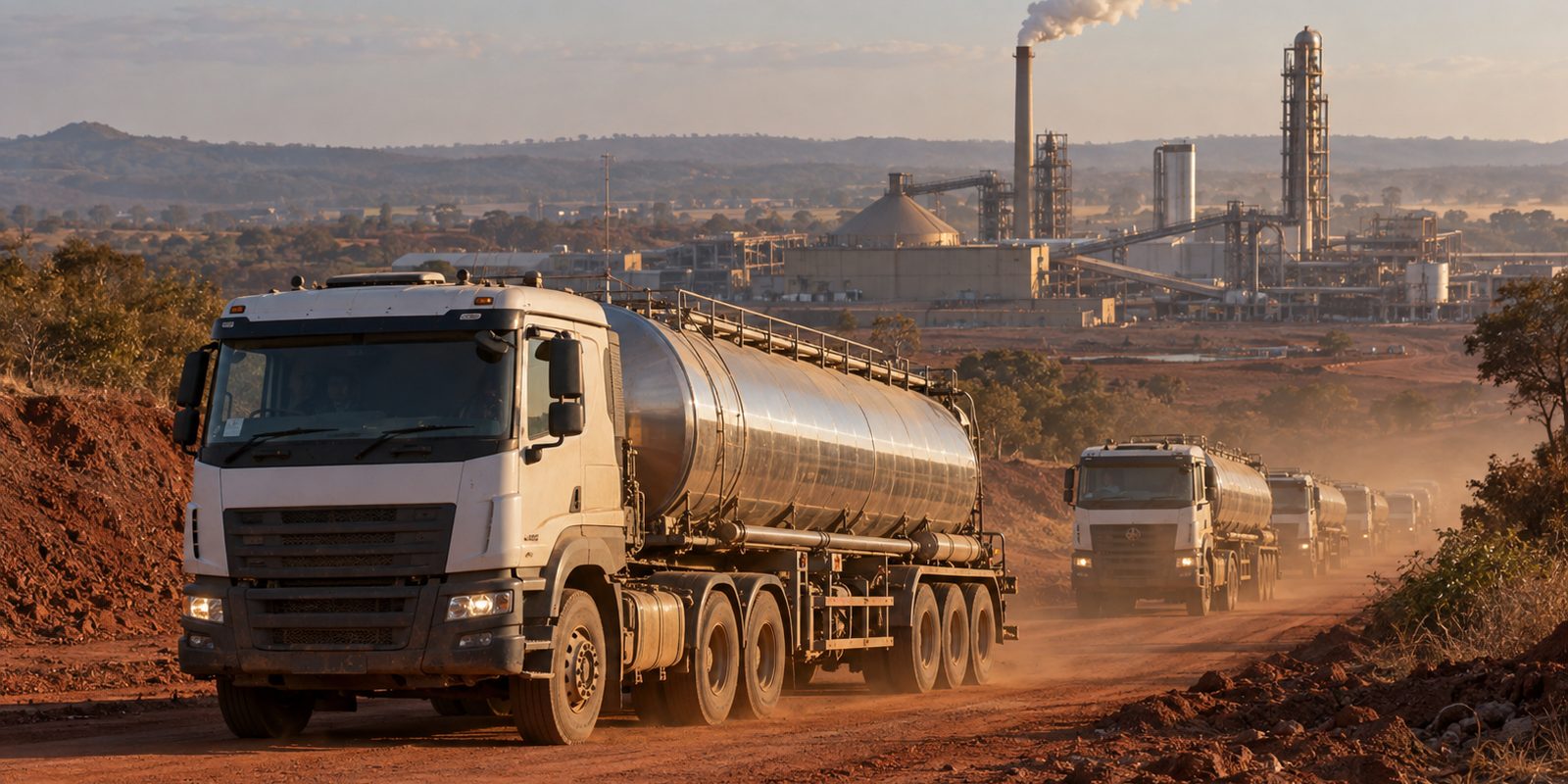
Between September 2025 and mid-2026 the Copperbelt went through its tightest sulphuric acid market in more than a decade. Operators cut irrigation rates on leach pads, rationed acid between circuits and, in some cases, considered output cuts. This note sets out what happened, what it did to prices, and what a procurement team in Lubumbashi or Kolwezi can do about it.
A structural deficit that predates the crisis
The DRC copper industry consumed close to 6 million tonnes of sulphuric acid in 2024, roughly half of the whole southern African demand [1]. Only part of it is made in the country. Historically the balance came from Zambian smelters, which produce about 2 million tonnes a year as a by-product of copper smelting and exported the surplus across the border [2]. In 2024 that trade was worth about US$58 million according to UN Comtrade data [3]. The rest comes from sulphur-burning plants built on the Congolese side by Sicomines, Gécamines, Tenke Fungurume, Huayou (4,000 t/day) and Shalina Resources (600 t/day), which together pull in more than 500,000 tonnes of imported sulphur every year [1].
What happened in 2025-2026
- September 2025: Zambia bans sulphuric acid exports outright as its own stocks run down [3][4].
- March 2026: the ban is replaced by a permit system with capped volumes [3][4].
- April 2026: Mopani announces a 40 to 45 day smelter shutdown between August and mid-September, and Chambishi a two-month stop until August, removing a large slice of by-product acid exactly when the DRC needs it [2].
- 15 May 2026: Commerce minister Chipoka Mulenga clears Chambishi Copper Smelter and Mopani Copper Mines to resume limited exports; the trader Alliswell Investment receives a 5,000-tonne permit [4].
Global sulphur and acid markets were disrupted at the same time by the conflict in the Middle East, which pushed up the cost of imported sulphur for the Congolese burners [2]. In the first quarter of 2026, Kamoa-Kakula's smelter became a net seller of acid into the local market, one of the few new sources to appear [3].
What it did to prices
Shanghai Metals Market reported delivered-to-plant sulphuric acid prices in the DRC of US$1,000 to 1,400 per tonne in April 2026, with sulphur quoted at US$1,500 to 1,800 per tonne delivered at port (DAP) and US$2,300 to 2,500 delivered duty paid (DDP) [5]. For comparison, price-reporting agencies put the global average acid price in the low hundreds of dollars per tonne over the same period [6]. The gap is the cost of being landlocked, of a captive market and of traders at Dar es Salaam holding stock while waiting for higher prices [5].
| Indicator | Value | Source |
|---|---|---|
| DRC acid consumption, 2024 | ≈ 6 million t | [1] |
| Zambian smelter acid output | ≈ 2 million t/year | [2] |
| Zambia to DRC acid trade, 2024 | US$ 58.2 million | [3] |
| Delivered price in DRC, April 2026 | US$ 1,000 to 1,400 /t | [5] |
| Sulphur DDP Copperbelt, April 2026 | US$ 2,300 to 2,500 /t | [5] |
| Imported sulphur for DRC burners | > 500,000 t/year | [1] |
Five ways to protect a plant
- Contract volumes ahead of the Zambian smelter maintenance calendar. Shutdowns are announced months in advance; the acid gap is predictable even when the price is not.
- Diversify the source: Zambian by-product acid, Congolese sulphur-burner acid and seaborne acid via Dar es Salaam or Beira do not fail at the same time.
- Hold sulphur as well as acid where the site has a burner. Sulphur is easier to store and ships as dry bulk.
- Reduce consumption at the plant: a tighter free-acid target in raffinate and better grind control halved acid use at one DRC operation between 2015 and 2017 [7].
- Work with a Congolese supplier registered with the subcontracting regulator. Since January 2026 the ARSP forbids mining companies from trading reagents such as sulphuric acid and quicklime directly; the activity is reserved to approved subcontractors [8].
Where PANATRADE fits
PANATRADE sources sulphuric acid and sulphur from regional and overseas producers, arranges the road corridor to Lualaba, Haut-Katanga and Tanganyika, and handles the dangerous-goods documentation. If your acid contract expires during the next Zambian maintenance window, ask us for a quote now rather than in August.
Need these products delivered to site?
Request a quote →Sources
- Sulphur and sulphuric acid in southern Africa, BC Insight / CRU, Sulphur magazine n°421, 21 Nov 2025.
- Zambia smelter shutdowns threaten copper output and sulphuric acid supply, Business Day (Reuters), 20 Apr 2026.
- Zambia's sulphuric acid exports to DR Congo: 2026 crisis explained, Discovery Alert, 18 May 2026.
- Zambia eases ban on sulphuric acid exports to Congo as stocks recover, minister says, CNBC Africa (Reuters), 15 May 2026.
- Stable sulphur and sulphuric acid supply in Zambia and DRC, prices fluctuate at high levels in DRC, Shanghai Metals Market (SMM), 21 Apr 2026.
- Sulphuric acid prices, trend, chart, index and forecast 2026, IMARC Group, 2026.
- Alexander D. et al. — Innovative process design for copper-cobalt oxide ores in the DRC, Journal of the SAIMM, vol. 118 n°11, 2018.
- L'ARSP interdit à toute entreprise minière la commercialisation directe des réactifs miniers (acide sulfurique, chaux vive, charbon et assimilés), ARSP, communiqué, 12 Jan 2026.
Figures quoted are those published by the sources listed above at the date of writing; they vary by site and over time. This article is general information, not process or legal advice.