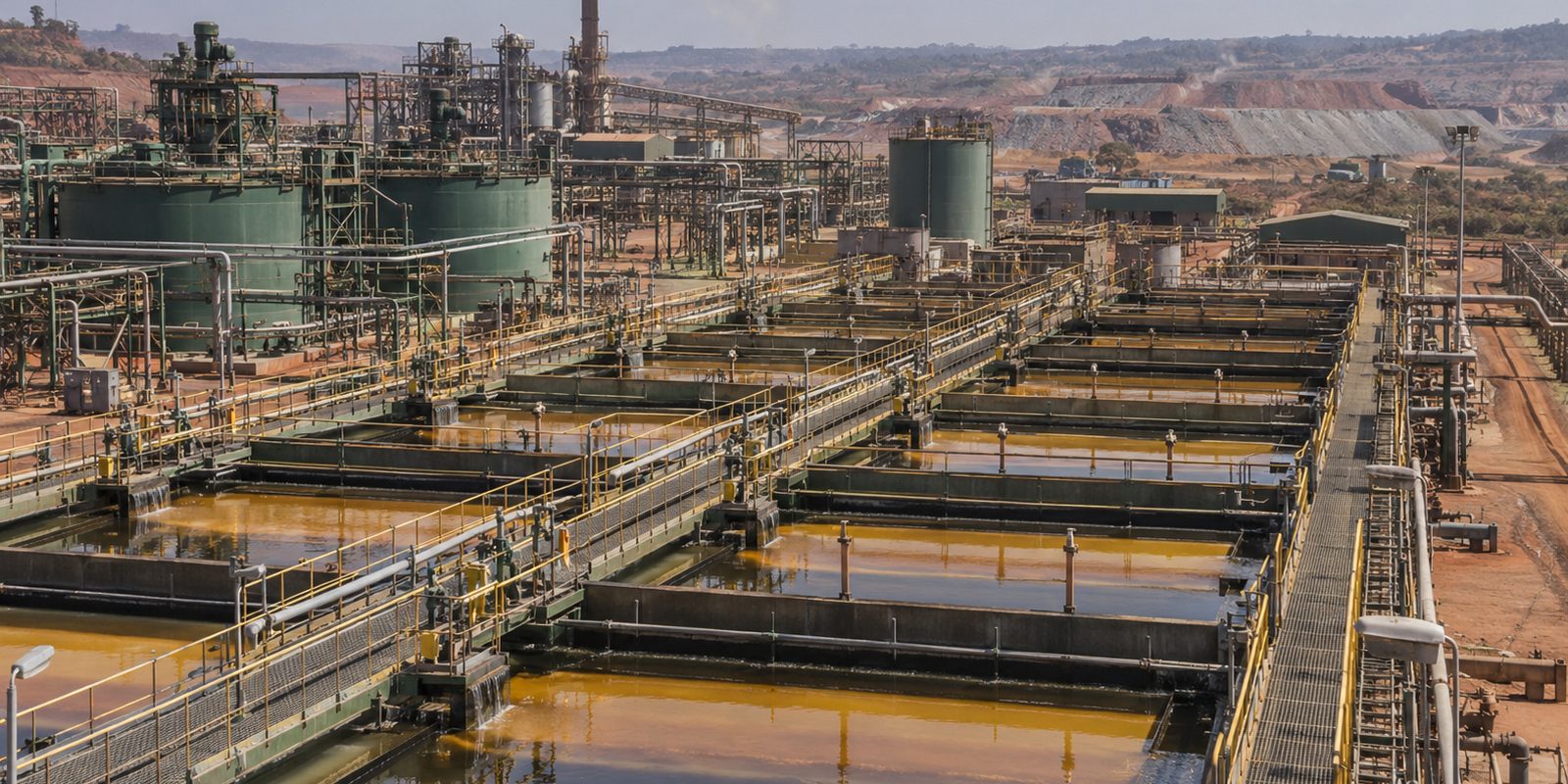
Every copper-cobalt plant in the Copperbelt that leaches the ore, extracts the copper with a solvent and then plates it by electrowinning (the so-called SX-EW process) runs on a short list of chemicals. Miss one delivery and the plant slows down; over-order and working capital sits in a warehouse in Kolwezi. This guide walks through the flowsheet stage by stage, names the reagent used at each step, and gives the consumption figures that have been published for operations in the Democratic Republic of the Congo (DRC). Figures vary widely with mineralogy, so treat them as orders of magnitude to check against your own plant data.
1. Leaching: sulphuric acid and a reductant
Sulphuric acid is the largest single reagent by tonnage. The DRC copper industry consumed close to 6 million tonnes of acid in 2024, about half of the regional total, according to CRU's Sulphur magazine [1]. At plant level, the consumption depends on gangue acid-consumers (dolomite, carbonates) far more than on the copper grade itself. Published heap-leach test work on oxide copper ores gives 18 to 57 kg of acid per tonne of ore [2]; agitated tank leaching of the dolomitic Katangan ores sits well above that, which is why acid is usually the first line of the reagent budget.
The good news is that consumption is controllable. At one DRC copper-cobalt oxide operation, acid consumption was halved between 2015 and 2017 by tightening the free-acid target in raffinate to below 30 g/L and by optimising the grind, as reported in the Journal of the Southern African Institute of Mining and Metallurgy [3].
Cobalt in Katangan ores is mostly heterogenite, in which a large share of the cobalt is trivalent and will not dissolve in acid alone. A reductant is required. Sodium metabisulphite (SMBS) is the most common: it reacts with acid to release sulphur dioxide, which reduces Co(III) to soluble Co(II) [4]. At Gécamines' Shituru plant, the reported requirement was about 0.8 tonne of SMBS and 1.2 tonne of copper powder per tonne of cobalt produced, and reagents represented roughly 47% of the cobalt operating cost [5]. Some plants burn sulphur and feed SO2 gas directly instead.
2. Iron and aluminium removal: lime or limestone
Before cobalt can be recovered, iron, aluminium and part of the manganese are precipitated by raising the pH of the copper raffinate with lime (quicklime CaO or hydrated lime Ca(OH)2) or limestone. Lime is cheap and widely available in the region, but each tonne brings calcium into the circuit and produces gypsum, which adds to filtration load and residue volume [6]. Quality matters: reactivity and available CaO content decide how many tonnes you actually need.
3. Copper solvent extraction: extractant and diluent
Copper is transferred from the pregnant leach solution into an organic phase made of an oxime extractant dissolved in a hydrocarbon diluent. Copperbelt plants run unusually strong organics: the 2016 review by Sole and Tinkler reports about 35 vol.% extractant at Mutanda for a pregnant leach solution (PLS) at 22.5 g/L copper and 33 vol.% at KCC for 26 g/L [4]. Diluents with 8 to 25 vol.% aromatics are preferred for their solvating capacity, and the same review recalls that South African refinery shutdowns in 2014 cost 137 days of diluent production, a reminder that diluent supply is a real operational risk [4].
Extractant losses in the region are much higher than design values because of crud formation and organic entrainment: actual usage of 3 to 6 kg per tonne of copper is reported, against much lower textbook figures [4]. A diluent-wash stage ahead of conventional SX, introduced at one DRC plant to handle colloidal silica, cut extractant and diluent consumption by 75% and 65% respectively [3].
4. Cobalt precipitation: magnesium oxide, caustic soda or lime
After copper SX and impurity removal, cobalt is precipitated as a hydroxide. Magnesium oxide is the reagent of choice in the region: Ruashi and Chemaf both produce cobalt hydroxide by precipitation with MgO [4]. Its slow hydration gives a gentle pH rise, which limits the co-precipitation of impurities and yields a cleaner, more filterable product than a caustic soda spike [7]. Caustic soda (NaOH) is used for final pH trimming or in circuits where calcium and magnesium must be kept out of the product; lime is the low-cost option when product grade is less critical [6]. Sodium hydrosulphide (NaHS) and sodium sulphide (Na2S) are used where a sulphide precipitate is wanted, or to strip copper from cobalt-bearing solutions.
5. Electrowinning and utilities
Electrowinning consumes little reagent by tonnage: cobalt sulphate and guar-type smoothing agents, plus acid make-up. The real consumables are cathode blanks, anodes and power, which often means diesel and fuel oil for gensets where grid supply is unreliable. Metallurgical coke and sulphur enter the picture when a site runs a smelter or an on-site sulphur burner to make its own acid.
Indicative reagent list for a Copperbelt SX-EW plant
| Stage | Reagent | What decides consumption |
|---|---|---|
| Leach | Sulphuric acid (H2SO4) | Gangue mineralogy, free-acid target, grind size |
| Leach | SMBS or SO2, ferrous sulphate | Share of Co(III) in heterogenite, redox control |
| Impurity removal | Lime, limestone, MgO | Fe/Al/Mn load, target pH, reagent reactivity |
| Copper SX | Oxime extractant + diluent | Crud, entrainment, silica, aromatic content |
| Cobalt precipitation | MgO, NaOH, lime, NaHS/Na2S | Product grade required, Mg and Ca limits |
| Utilities | Diesel, fuel oil, coke, sulphur | Power reliability, on-site acid or smelting |
How to size your orders
Start from your own mass balance: tonnes of ore per month, acid consumption in kg per tonne from the last quarter's actuals, cobalt tonnes for the reductant, and the pH steps for lime and MgO. Add a safety stock that covers the real transit time from the port, not the theoretical one. Corridor delays of several days at Kasumbalesa are common, and a plant that runs out of SMBS loses cobalt recovery immediately. PANATRADE supplies the full list above to operations in Lualaba, Haut-Katanga and Tanganyika, with delivery to site and the documentation required by Congolese regulations.
Need these products delivered to site?
Request a quote →Sources
- Sulphur and sulphuric acid in southern Africa, BC Insight / CRU, Sulphur magazine n°421, 21 Nov 2025.
- Investigation of affecting parameters on heap leaching performance and reducing acid consumption of low grade oxide-sulfide copper ore, ResearchGate, 2017.
- Alexander D., van der Merwe C., Lumbule R., Kgomo J. — Innovative process design for copper-cobalt oxide ores in the DRC, Journal of the SAIMM, vol. 118 n°11, 2018.
- Sole K.C., Tinkler O.S. — Copper solvent extraction: status, operating practices, and challenges in the African Copperbelt, Journal of the SAIMM, vol. 116 n°6, 2016.
- Use of sulphur dioxide as reducing agent in cobalt leaching at Shituru hydrometallurgical plant, ResearchGate, 2015.
- Selective precipitation of nickel and cobalt (US6409979B1), Google Patents, 2002.
- Application of magnesium oxide in cobalt precipitation agent, Magnesium King, 2024.
Figures quoted are those published by the sources listed above at the date of writing; they vary by site and over time. This article is general information, not process or legal advice.