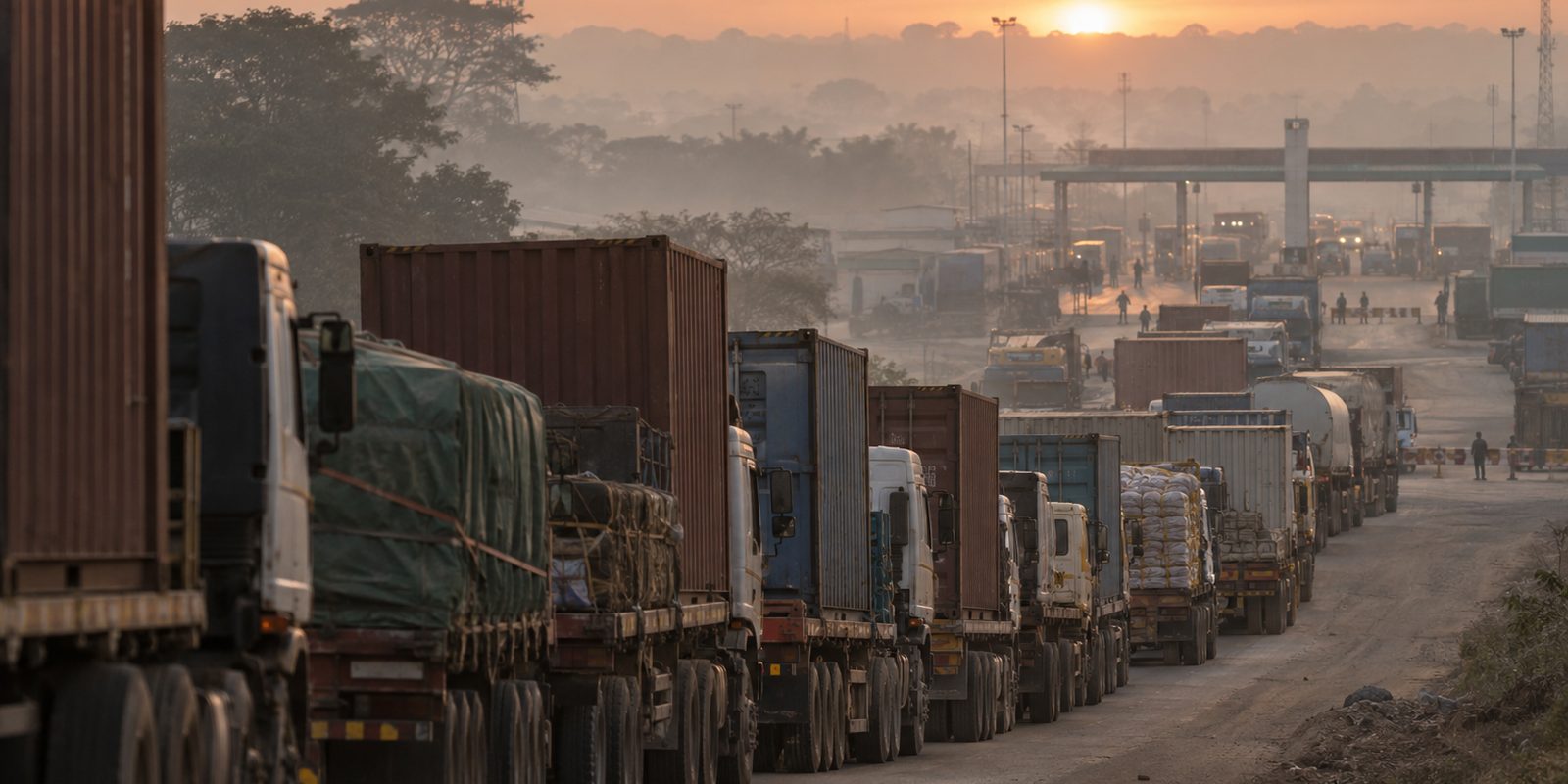
Reagents reach the Copperbelt by truck, and the trucks come from four directions: Durban in the south, Dar es Salaam in the east, Walvis Bay in the west and, since 2025, the rehabilitated Lobito railway from Angola. Each corridor has its own distance, its own borders and its own way of failing. For a buyer, the choice of corridor is embedded in the delivered price and the reliability of the supplier's promise. This update compares the four on published figures and on what changed over the last eighteen months.
The four routes in numbers
| Corridor | Distance to Kolwezi / Lubumbashi | Transit | Indicative cost | Borders |
|---|---|---|---|---|
| Durban (North-South) | ≈ 3,000 km | 40 to 50 days round trip by truck [1] | > €150 to 200 /t [1] | Beitbridge, Chirundu, Kasumbalesa |
| Dar es Salaam (Central / TAZARA) | ≈ 2,000 km | 40 to 50 days round trip by truck [1] | > €150 to 200 /t [1] | Tunduma-Nakonde, Kasumbalesa |
| Walvis Bay (WBNLDC) | 2,615 km to Lubumbashi | 6 to 7 days one way [2] | Not published | Katima Mulilo, Kasumbalesa |
| Lobito (rail) | 1,739 km from Kolwezi | Under 8 days [1] | €90 to 120 /t [1] | Dilolo (rail) |
Two cautions on the table. Most published costs and days concern copper cathode exports, because that is the flow that pays for the trucks; inbound reagents ride the same vehicles as backhaul, so the same corridors and borders apply, but the rates you are quoted will differ. And the Walvis Bay figure is the corridor group's own transit target [2], not a measured average.
Kasumbalesa, the bottleneck that all road corridors share
Three of the four routes cross into the DRC at Kasumbalesa, and that is where reliability is lost. In January 2025 the queue on the Zambian side reached 56 km after a new electronic seal clearance system was introduced on the Congolese side; more than 1,500 trucks were stranded, and the crossing was moved to 6 am to 8 pm opening hours and a 500-trucks-per-day increase to clear it [3]. Alternative posts at Mokambo and Sakania could not be used because the Zambian revenue system showed them as unavailable [3]. In February 2026 an ECDPM field note still described a 25 km line of trucks and drivers taking about five days to reach the front, with the bottleneck identified as the speed of Congolese customs clearance [4]. On the Congolese side, six toll booths line the 400 km from Kasumbalesa to Kolwezi [5]. The Walvis Bay corridor group is promoting a Kolwezi-Solwezi route through an alternative crossing precisely to bypass this post [2].
Dar es Salaam: the volume leader
Dar es Salaam handled 7.77 million tonnes of DRC-bound cargo in 2025/26, up 30% year on year, which is 53% of all transit cargo through the port and 23% of its total throughput [6]. In August 2026 Tanzania and the DRC signed a framework agreement on minerals and the DRC announced a dry port project in Dar es Salaam, without a budget or timetable yet [6]. The Chinese-funded modernisation of the TAZARA railway, launched in November 2025, targets 2.4 million tonnes a year [1]. For a reagent buyer, Dar es Salaam is the shortest sea-to-mine road distance and the port where traders hold acid and sulphur stock, which is also why prices there move with sentiment [7].
Lobito: the new export route, with an inbound question mark
The rehabilitated Lobito line moved more than 200,000 tonnes in its first full operational year, with anchor commitments above 470,000 tonnes a year and a transit under eight days from Kolwezi at a quoted €90 to 120 per tonne, 25 to 40% below the truck routes [1]. Kamoa-Kakula exports concentrate on it. The open question for a procurement team is the inbound leg: the railway will only be a reagent corridor once containerised chemicals move north on the wagons that carry copper south, and the operator's stated 2026 target is still 240,000 tonnes of copper [1].
Durban and Walvis Bay: the southern options
Durban remains the reference for high-value cathode because of port capacity and shipping frequency, at the cost of the longest road distance and the most borders. Round trips from Kolwezi were already 35 to 40 days in 2022, and Kamoa-Kakula's demand at that time pushed trucking rates 30 to 50% above market [5]. Walvis Bay offers a less congested port and a 6 to 7 day target transit to Lubumbashi [2]; Namibia opened a visa office in Lubumbashi in 2025 to support the corridor, but it still enters the DRC at Kasumbalesa.
What this means for a reagent order
- Ask for a price delivered to your site, not a price at the port. The transport risk is the supplier's to manage, and the delivered price should reflect the real transit, Kasumbalesa included.
- Ask which corridor and which border the supplier uses, and whether a second route is contracted. Dar es Salaam and Durban do not congest at the same time.
- Size safety stock in days of Kasumbalesa delay, not in days of driving. Five days of queue in February 2026 is the number to plan against [4].
- For dangerous goods, check that the corridor's transit countries accept the placarding and driver documents in the supplier's file.
- Watch Lobito for 2027 procurement: once northbound container services are regular, it will cut the delivered cost of imported reagents to Kolwezi.
PANATRADE routes reagents and consumables to Lualaba, Haut-Katanga and Tanganyika through Dar es Salaam, Durban and Walvis Bay, and tracks each consignment through the border. Ask us for a quote delivered to site, with the corridor and transit time stated.
Need these products delivered to site?
Request a quote →Sources
- The Lobito Corridor in 2026: complete guide, LobitoCorridor.com, 3 Jun 2026.
- The Walvis Bay-Ndola-Lubumbashi Development Corridor, Walvis Bay Corridor Group, 2026.
- Copperbelt border traffic eased but problems persist, Freight News, 15 Jan 2025.
- Byiers B. — Notes from Kasumbalesa: where 25 km of trucks meet bikes on the Lobito corridor, ECDPM, 17 Feb 2026.
- African copper, cobalt logistics chain under pressure as truckers avoid DRC, Fastmarkets, 19 Apr 2022.
- Tanzania and Congo bet on the Central Corridor for minerals, The Rio Times, 18 Aug 2026.
- Stable sulphur and sulphuric acid supply in Zambia and DRC, prices fluctuate at high levels in DRC, Shanghai Metals Market (SMM), 21 Apr 2026.
Figures quoted are those published by the sources listed above at the date of writing; they vary by site and over time. This article is general information, not process or legal advice.