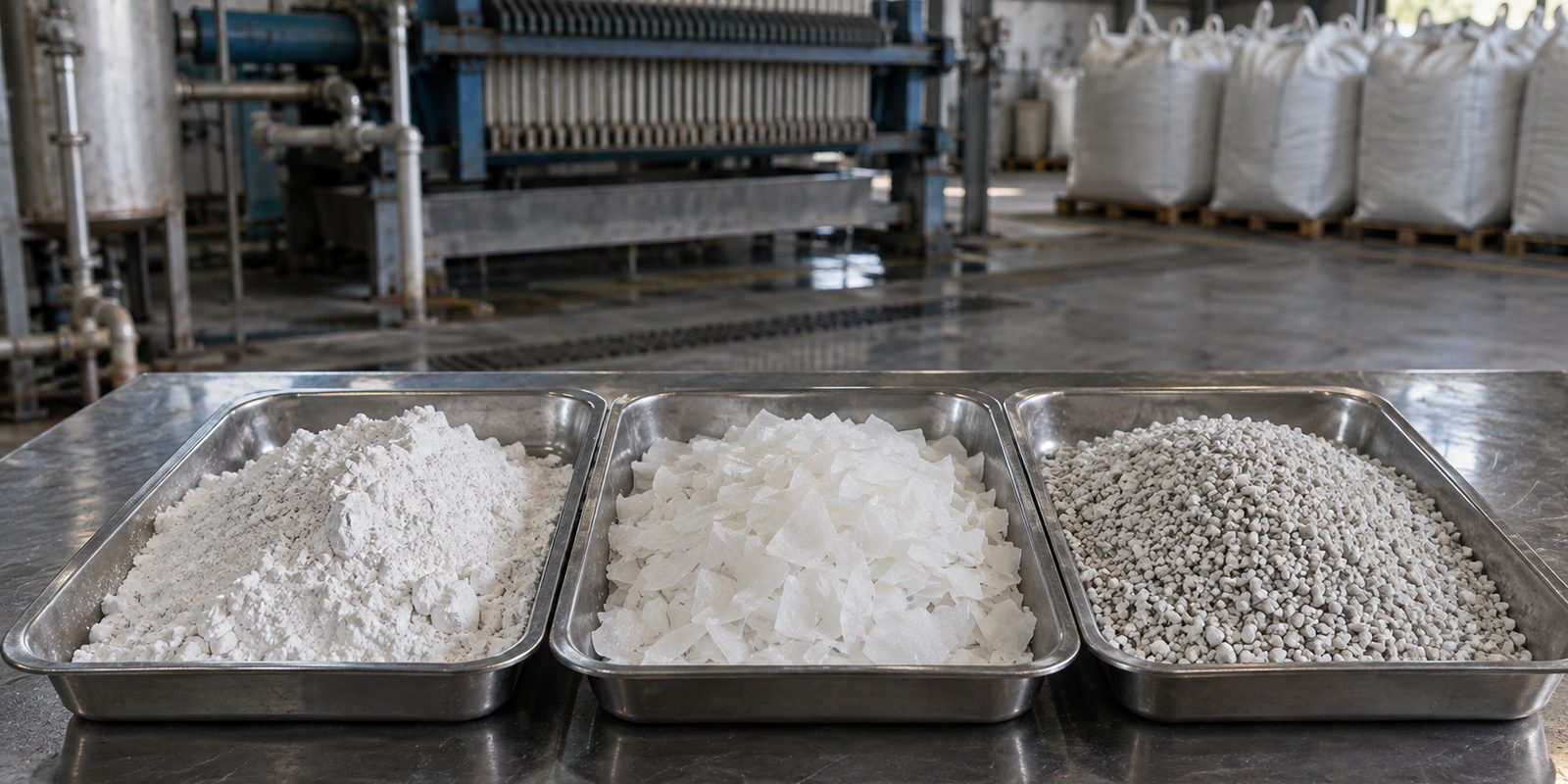
Three alkalis compete for the same job in a Copperbelt cobalt circuit: raising the pH of a sulphate solution so that cobalt drops out as a hydroxide. Lime is the cheapest per tonne, caustic soda is the most reactive, magnesium oxide gives the cleanest product. The right choice depends on the grade your buyer pays for, on what your filters can handle and on what you can reliably get delivered to site. This note compares the three on the criteria that matter to a metallurgist and a procurement manager.
What the chemistry asks for
Cobalt hydroxide precipitates in a narrow pH window, typically 8 to 9 [1]. Below it, recovery is incomplete; above it, manganese, magnesium and residual copper follow the cobalt into the solid and dilute the grade. The ideal reagent therefore raises the pH steadily, without local overshoots at the point of addition, and adds nothing that ends up in the product. No single alkali does all of that, which is why plants often combine two.
Lime: cheapest, but it brings calcium
Quicklime (CaO) and hydrated lime (Ca(OH)2) are the low-cost base for hydroxide precipitation and are produced in the region. Their drawback is well documented: lime introduces variable quantities of calcium into the circuit, which precipitates with sulphate as gypsum or bassanite and ends up mixed with the metal hydroxide [2]. That means a lower-grade product, more solids to filter and more residue to store. Lime is the natural choice for the upstream iron and aluminium removal step, where product grade does not matter, and for plants selling a lower-grade intermediate.
Caustic soda: precise, hazardous and expensive
Sodium hydroxide dissolves instantly and leaves no solid by-product, so it gives a calcium-free precipitate and is often used for final pH trimming [2]. It has two costs. The first is the price of the reagent itself, which is imported and sold in bulk at a premium in the DRC. The second is process control: caustic creates sharp pH spikes at the addition point, which co-precipitate iron, aluminium and manganese and force operators to back-titrate with acid [1][3]. It is also a hazardous liquid that requires trained handling, corrosion-resistant storage and a permit chain for road transport.
Magnesium oxide: the regional standard for saleable hydroxide
Magnesium oxide is a mildly alkaline solid that hydrates slowly to magnesium hydroxide in water. That slow release is exactly what the cobalt circuit needs: the pH climbs without spikes, impurity co-precipitation is lower and the precipitate settles and filters better than with caustic [1][3]. In a documented industrial trial, replacing 1,000 gallons per month of 50% caustic with 750 gallons of a magnesium hydroxide slurry saved about US$1,400 per month, and a twelve-fold overdose of the magnesium reagent kept the pH below 9, where an equivalent caustic overdose would have required neutralising with sulphuric acid [3]. Ruashi and Chemaf both produce their cobalt hydroxide by MgO precipitation, and a 2022 study on Ruashi ore used MgO followed by caustic for the final adjustment to pH 8.2 [4][5].
MgO is not free of drawbacks. Its reactivity depends on how it was calcined: an over-burnt, low-activity grade hydrates too slowly and drags out the precipitation, so the specification you buy against matters as much as the price. Some magnesium is carried into the product, and buyers of cobalt hydroxide set a limit on it. The reagent is imported, so lead times and corridor delays apply.
Side-by-side
| Criterion | Lime (CaO / Ca(OH)2) | Caustic soda (NaOH) | Magnesium oxide (MgO) |
|---|---|---|---|
| Cost of reagent | Lowest, regional supply | Highest, imported liquid or flake | Intermediate, imported solid |
| pH control | Coarse, gypsum formation | Very fast, prone to local spikes | Gradual, self-buffering |
| Impurity in product | Calcium, gypsum | Sodium negligible | Some magnesium |
| Filtration and residue | Highest solids load | Lowest solids, fine precipitate | Dense, well-settling solids |
| Handling | Dusty, exothermic slaking | Hazardous corrosive liquid | Non-hazardous solid |
| Typical use | Fe/Al removal, low-grade product | pH trimming, calcium-free circuits | Saleable cobalt hydroxide |
A practical rule
Most Copperbelt operations end up with lime for impurity removal, MgO as the main cobalt precipitant and caustic in small quantities for trimming. The tonnage split then follows your iron-to-cobalt ratio and your buyer's calcium and magnesium limits. Before changing reagent, run the precipitation on your own solution with the actual grade you intend to buy: MgO activity and lime available-CaO content vary from one origin to another, and a cheaper tonne that needs 30% more dosage is not cheaper.
PANATRADE supplies quicklime, hydrated lime, caustic soda and magnesium oxide to cobalt producers in the DRC, with certificates of analysis on every batch. Tell us your target grade and monthly cobalt tonnage and we will quote the reagent set that fits.
Need these products delivered to site?
Request a quote →Sources
- Application of magnesium oxide in cobalt precipitation agent, Magnesium King, 2024.
- Selective precipitation of nickel and cobalt (US6409979B1), Google Patents, 2002.
- Replacing caustic soda with magnesium hydroxide for metal ion precipitation, Calix, 2023.
- Sole K.C., Tinkler O.S. — Copper solvent extraction: status, operating practices, and challenges in the African Copperbelt, Journal of the SAIMM, vol. 116 n°6, 2016.
- Geometallurgy of cobalt black ores in the Katanga Copperbelt (Ruashi Cu-Co deposit): a new proposal for enhancing cobalt recovery, Minerals (MDPI), vol. 12 n°3, 2022.
Figures quoted are those published by the sources listed above at the date of writing; they vary by site and over time. This article is general information, not process or legal advice.